
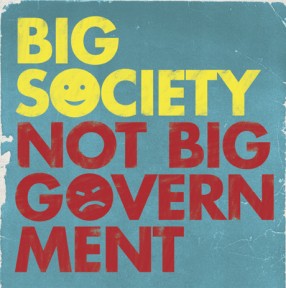
Welcome to the Big Society…..well?
“the biggest, most dramatic redistribution of power from elites in Whitehall to the man and woman on the street” Rt. Hon David Cameron Prime Minister (19 July 2010).
The words of a man excited with passion, a vision and a love for his Country. The Conservative Party went to the polls last year with a resonating vision of handing power back to the public, which the Prime Minister describes as his ‘mission’. Sounds good but details of the ‘Big Society’ were lacking in clarity and the Government can hang their heads in dismay at the inept communication of the whole project. The novelty had never been explored before, had it?
There has been little fundamental change in the relationship between the State, its citizens and civil society – much of it due to political ignorance on the significance of ‘voluntary initiative’. That is not to say Governments have not made attempts. The 1979 Conservative administration gave huge support to the voluntary sector through funding initiatives. From 1979-80 to 1986-87, public sector direct grant support for the voluntary sector increased by over 90% in real terms. The 1997 Labour Government started this vision of a socio-political significance but that vision soon gave way to the ‘special relationship’.
So what is the Big Society?
“You can call it liberalism. You can call it empowerment. You can call it freedom. You can call it responsibility. I call it the Big Society”. Right, so there we have it. But what does it mean for you and I? It’s about getting involved with people from your local community to build a better community – “It’s time to stand up and say WE matter; WE demand recognition; WE demand a fair chance; WE demand a voice” (East Ham Conservative Party, Little Ilford Ward 2010).
Yes it’s about volunteering. We live in difficult times – high unemployment, education facing unprecedented external pressure, youths lacking essential skills which the modern (international) workforce demands, Councils spending our money on things which…well we don’t really know, other than the massive salaries some of the top Council officials receive and, not to forget the Government cuts. The cuts are severe and harsh taking the public moral to a seldom place we would rather not be. We are all sceptical about Government cuts. But we also understand the need, whether we like it or not.
At the heart of the Big Society are the local communities and injecting new life and form into the concept of co-ops. Co-ops do not have shareholders – they have a one member one vote system, so no-one single person has majority control and voice (oh dear Rupert Murdoch). There are many examples of communities coming together as co-ops, such as the Blockley Co-Operative Society who successfully come together to run their own shop, café and post office. There are over 250 such co-ops throughout the UK in various sizes. Another example of the Big Society concept can be found at the Windsor and Maidenhead Council, where Labour’s policy of fining people for not using the recycling bins properly was not working. Conservative Councillors in agreement with the local community decided to the best way to reduce the costs of recycling was to encourage local residents to use the recycling bins in a proper manner by the use of ‘reward points’. The more they recycle the more reward points residents receive. Points which can be used at local businesses for money off and special offers. The result has been a reduced landfill tax bill and about 2 million pounds injected into the local economy through the rewards scheme.
What does the Government propose to work the Big Society?
Lord Wei is charged with putting the Big Society into action. Briefly, it is proposed the voluntary citizen service for young people should have 6,000 people involved in a couple of years. There will also be a Big Society Day to celebrate the idea of volunteering.
Second, money will be put up to fund social projects with grants and a big society bank – loaded with hundreds of millions of pounds collected from dormant accounts.
Third, the Government will capitalise an army of community organisers that will become the “catalyst” for communities to band together and challenge the apparently arbitrary decisions made about public services in their name.
The social action agenda.
Think about what needs to be improved in your local area in terms of priority. Gather members of the community together and come up with a project. Approach local businesses for expert assistance and financial assistance. Utilise the skills at your disposal and you may just be surprised at the results.
ATTIC RAHMAN
19 December 2010


Leave a Reply